This Thursday at the Uni we played another game of Battle Group Kursk, this time with the aim of getting a better understanding of indirect artillery fire and air raids. The scenario was loosely based around the struggles in the river Psel Bridgehead on the 12th July 1943 between a Totenkopf battlegroup and elements of the 52nd Guards Rifles. The scenario I prepared quotes liberally, but in bowdlerised format, from Dennis Showalter's excellent 'Armour and Blood', which for me is the seminal overall account of Kursk.
Ground:
 Rising ground
stretches North from the the Psel River around Bogoroditskoe to Hill 226.6,
behind which lies the key Karteschevka-Prokhorovka road. (Kart-Prok Road).
Rising ground
stretches North from the the Psel River around Bogoroditskoe to Hill 226.6,
behind which lies the key Karteschevka-Prokhorovka road. (Kart-Prok Road).
The area is dotted with woods, folds in the ground and small villages.
The outskirts of the village of Mikhailovka is on the Eastern edge of the table.
The yellow rectangle represents the 12 x 6 foot table.
Totenkopf’s forward edge of the battle area is delineated by the Blue
map trace, just South of the railway embankment.
Soviet elements of 52nd Guards Rifle Division are located
North of the Red trace.
Situation:
" II SS Panzer Corp commander Paul Hausser’s orders for July 12 were
straightforward. No more fooling around. This time apply the panzers' mantra:
Klotzen, nicht kleckern ("Stomp, don't tickle" is an approximate
rendering of the German colloquialism). That, however, did not mean a massed
frontal attack, three divisions abreast, into the teeth of Russian guns.
Hausser intended a sequential operation. Totenkopf's armored battle group would
cross the Psel and push north, then turn east on reaching the
Karteschevka-Prokhorovka road, which on the map offered a clear route into the
rear of the main Russian position.
 The Sixty-ninth Army
had taken a predictable initiative by ordering its counterintelligence
department-a uniformed branch of SMERSH (the Russian acronym for "Death to
Spies")-to prevent further abandonment of the battlefield. By 4:00 P.M. on
July 13, the responsible senior officer reported 2,842 officers and men
"detained" and the mass retreat stopped.
The Sixty-ninth Army
had taken a predictable initiative by ordering its counterintelligence
department-a uniformed branch of SMERSH (the Russian acronym for "Death to
Spies")-to prevent further abandonment of the battlefield. By 4:00 P.M. on
July 13, the responsible senior officer reported 2,842 officers and men
"detained" and the mass retreat stopped.
Otherwise, the front commander was playing with an empty pocket. Every
available formation of any useful size was committed to the defense or the
counterattack. The commander of the 81st Guards Rifle Division ordered his
regimental commanders to "introduce the strictest discipline" and
"implement Order No. 227." Order No. 227, mentioned earlier in the
text, was Stalin's "not a step back" directive of July 28, 1942,
forbidding any commander to retreat without orders and allowing the summary
execution of "panic-mongers and cowards" by specially organized
"blocking detachments." That aspect of the order had been unofficially
dropped a few months later. But on July 12, the Sixty-ninth Army's SMERSH
detachment improvised seven of them. But if the Soviet defenses were shaken,
the front never cracked.
 For their part, the Germans were showing the effects of wear, tear, and
grit in the machinery. Here, as elsewhere in Manstein's sector, it was not just
a matter of too few tanks at the sharp end. Too many veteran crewmen, too many
experienced company officers, were gone. At dawn, Totenkopf's advancing panzer
group discovered that the Russian infantry to its front had been relieved by
the Fifth Guards Army's fresh 3rd Guards Rifle Corps: three divisions
reinforced by extra guns, rocket launchers, and antitank guns.
For their part, the Germans were showing the effects of wear, tear, and
grit in the machinery. Here, as elsewhere in Manstein's sector, it was not just
a matter of too few tanks at the sharp end. Too many veteran crewmen, too many
experienced company officers, were gone. At dawn, Totenkopf's advancing panzer
group discovered that the Russian infantry to its front had been relieved by
the Fifth Guards Army's fresh 3rd Guards Rifle Corps: three divisions
reinforced by extra guns, rocket launchers, and antitank guns.
Totenkopf's panzer grenadiers were sufficiently hard pressed that tanks
repeatedly had to be brought forward in support. Heavy Soviet artillery fire
forced SS riflemen to seek protection under their own tanks-a last resort for
an experienced infantryman. Then the Shturmoviks joined in-unopposed.
 The initial objectives of Totenkopf's armor, however, remained: two
hills high enough to command the surrounding terrain.
The initial objectives of Totenkopf's armor, however, remained: two
hills high enough to command the surrounding terrain.
Occupying that ground were two Guards rifle divisions. The 52nd, moving
into its own assault positions, was taken by surprise when the SS appeared to
the front. But the Guardsmen were a match and more for Totenkopf's panzer
grenadiers in both courage and tactical skill. According to a political
commissar, their political spirit was also high. "
Mission:
German Commander’s Intent – Seize Hill 226.6 to dominate the Kart –
Prok Road.
Totenkopf Battle Group ‘Kaiser’ is to clear the wooded area South of
the Kart – Prok Road of enemy infantry and guns.
Execution:
 The Soviet player will deploy first anywhere N of the Red map trace,
including positions in Mikhailovka if desired. Any positions in
the wooded area, or Mikhailovka village, may be dug in prior to game start. All
other positions are hasty and have no protective value.
The Soviet player will deploy first anywhere N of the Red map trace,
including positions in Mikhailovka if desired. Any positions in
the wooded area, or Mikhailovka village, may be dug in prior to game start. All
other positions are hasty and have no protective value.
The German player will then deploy on the start line, anywhere up to
the Blue Map trace. All units to be on table.
The Soviet player will then start with one Sturmovik air raid, 2 A/C
each carrying one large bomb, and 1 artillery bombardment of both 122mm
batteries.
The German player will then start the first ‘free’ move…The game will
end when either BG reaches its BG rating or the German Player has cleared the
objective.
Air strikes. Preliminary Soviet strike as above, Stuka strike as below,
then if drawn, armament as specified.
Local rules. As detailed below,
Totenkopf AFVs made a point of crushing Soviet slit trenches. Any unpinned
German tank which spends half its movement on a Soviet position destroys that
gun or section.
Battle Group ‘Kaiser’
3 x Tiger 1E
3 X Pz IV
6 x Pz III
2 x Panzer Grenadier Platoons with 251 APC
1 x Panzer Grenadier Weapons platoon with 251 APC (3 x 81mm Mortar, 2
X MFC, 2 x SFMG)
2 x Wespe and support group, FAO (netted and surveyed prior to game
start)
1 X Stuka Strike (2 x Medium Bomb) Order move before.
Battle Group Rating 37 (Exhausted
troops) Elite Orders 3D6+2 (Exhausted
troops)
|
52nd Guards Rifle
Division ‘Mikhailovka PakFront’
1 x 76.2mm DP AT gun battery (4)
1 x 57mm AT Gun battery (4)
2 x 122mm Howitzer batteries (4 each)
1 x AT platoon (2 x 45mm AT gun)
1 x MG Platoon (4 x Maxim)
1 x Rifle Platoon (4 x Infantry Squads)
Battle Group Rating 25
Inexperienced Orders 2D6+1
|
How it played
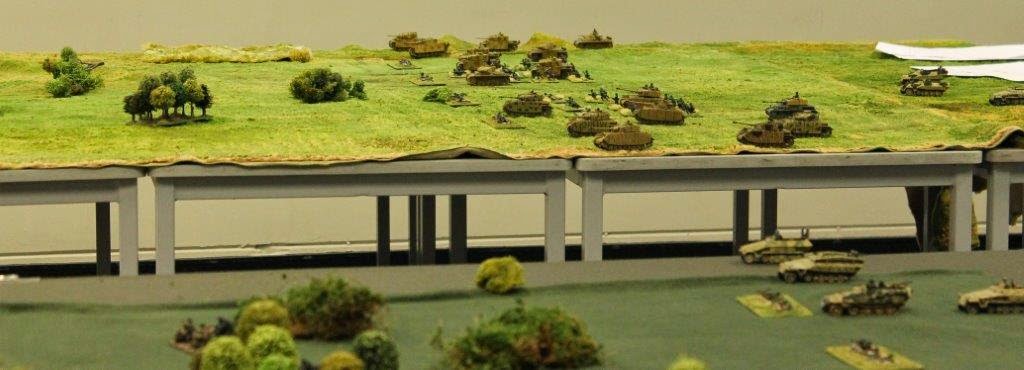
.jpg) Its fair to say the initial Soviet airstrike lived up to its historical role, knocking out the handful of Tigers still remaining to Totenkopf. Glum faces on the German team! To add insult to injury the preliminary Soviet 122mm Howitzer bombardment then pinned half the remaining panzers... Well, if you will send an entire armoured division into the rear zone where all the guns are, across a single river crossing...
Its fair to say the initial Soviet airstrike lived up to its historical role, knocking out the handful of Tigers still remaining to Totenkopf. Glum faces on the German team! To add insult to injury the preliminary Soviet 122mm Howitzer bombardment then pinned half the remaining panzers... Well, if you will send an entire armoured division into the rear zone where all the guns are, across a single river crossing...
Did I mention the Soviets has lots of guns? To many for our command dice rolls, anyhow, as it left very few order activations for our infantry and anti-tank guns by the time we'd fired off two whole batteries of howitzers!
.jpg) Nonetheless with admirable fortitude the German team pressed on - it was beginning to look as if their plan was to clear out the village of Mikahilovka which presented a threat to their right flank from the battery of 57mm ZIS 2s we had in there...
Nonetheless with admirable fortitude the German team pressed on - it was beginning to look as if their plan was to clear out the village of Mikahilovka which presented a threat to their right flank from the battery of 57mm ZIS 2s we had in there...
.jpg) I was too hard pressed trying to coordinate the Soviet defence with consistently low orders rolls to take any photos, but John's infantry and panzers worked together with faultess all-arms cooperation to systematically clear the village - but not without cost and slowing up the main advance as the German panzers hesitated to present their flanks until the village was cleared...
I was too hard pressed trying to coordinate the Soviet defence with consistently low orders rolls to take any photos, but John's infantry and panzers worked together with faultess all-arms cooperation to systematically clear the village - but not without cost and slowing up the main advance as the German panzers hesitated to present their flanks until the village was cleared...
However it was our artillery which was holding the Totenkopf advance up, consistently pinning sufficient of their AFVs and infantry trying to advance up the centre of the table.
 So that it was actually the German panzer grenadiers that were making the running, forcing our forward observers to pull back from their forward positions on the edge of Hill 226.6. I think that the subsequent disruption to the previously continuous hail of effective artillery fire gave the German team the clue as to what they needed to do if they were to reach the objective - target our artillery with their pre-booked airstrike!
With devastating results! Most of our guns destroyed, those remaining pinned! This reduced our Battlegroup rating to a dangerously low level! The panzers forged ahead past the village with renewed confidence...Only to lose a few more Panzer IIIs to flanking shots from our remaining anti tank guns.
However as the German Panzer grenadiers eventually assaulted and destroyed the Russian infantry in the village, as feared our Battle Group rating tilted past break point - only to be told the Germans had also just reached theirs - with the objective, the woods, still untaken and full of fresh Russian infantry. We decided to call it a draw!
Most of the feedback from the players was positive about the scenario, although as always some players are more comfortable with absolute adherence to the rules and balanced point systems, whereas I prefer to think of the rules and points values as an aid to recreating a historical scenario. Given the historical outcome of the day's fighting, once again given in much abbreviated format below from Showalter, I think the scenario and game was a success. It was certainly in balance down to the wire!
What actually happened:
"Positions changed hands so often that the exact course of events
remains vague. The SS, with Stuka support as welcome as it was belated, made
enough initial progress to generate hope for the long-delayed linkup with
Leibstandarte.
German accounts describe spectacular explosions, huge fireballs-and
enough losses of their own to instill caution by the time Hill 226.6 was firmly
in German hands. The tanks and panzer grenadiers encountered a series of
defensive positions, some prepared and others improvised, all bristling with
antitank guns.
Totenkopf's tankers made a point of crushing trenches and foxholes,
burying defenders alive under their treads. But not until 3:00 P.M. did the
Germans begin breaking Soviet defenses beyond immediate restoration.
 Not all the comrades were valiant. Some of the 52nd's regiment and
battalion commanders reported sick, straggled to the rear, or just ran away.
When the panzers reached Hill 236.7, elements of the 95th Guards Rifle Division
also broke and scattered. But around 4:00 P.M., 33rd Corps ordered maximum
protective fire: every gun and rocket launcher that could come to bear was to
target Totenkopf's tanks, even if they were in Russian positions. The barrage
removed the impetus from an SS attack already eroded by a defense stubborn
enough in some positions to be suicidal.
Not all the comrades were valiant. Some of the 52nd's regiment and
battalion commanders reported sick, straggled to the rear, or just ran away.
When the panzers reached Hill 236.7, elements of the 95th Guards Rifle Division
also broke and scattered. But around 4:00 P.M., 33rd Corps ordered maximum
protective fire: every gun and rocket launcher that could come to bear was to
target Totenkopf's tanks, even if they were in Russian positions. The barrage
removed the impetus from an SS attack already eroded by a defense stubborn
enough in some positions to be suicidal.
Small-scale advances nonetheless continued. As of 10:45 P.M., Totenkopf
was comfortable reporting that its panzer group had reached the
Karteschevka-Prokhorovka road-a day late and a large number of men and tanks
short. On the map, only a few miles separated Totenkopf from the road leading
into Voronezh Front's rear zone.
By now, Totenkopf's panzer grenadier companies were down to fifty men
or fewer, so tired after days of close combat that the standard stimulants were
having an opposite effect. The panzer regiment had lost almost half its tanks
fighting its way out of the Psel bridgehead. Forty-five had been destroyed or
damaged, including all the Tigers. "


 No, the reason was I tried to turn it into a balanced scenario, and clearly got it wrong. So instead of a one sided, but historical game, we actually ended up with an interesting and thought provoking evening's play that seemed to get the most out of the Battle Group rules, although we did not have any infantry on the table.




.jpg)
.jpg)
.jpg)
.jpg)
.jpg)

.jpg)
.jpg)
.jpg)
.jpg)
.jpg)

