
On the 83rd anniversary of the Battle of the Java Sea, the Wollongong Wargamers used Nimitz rules to reprise this action, using 1:1200 scale models and a 12 x 6 foot table.


All the Allied cruisers were represented, and deployed in their correct order of sailing in Formation 1 (Line Astern of the Guide).


Liberties were also taken with the various destroyers - most of the Japanese and Dutch models were accurate, but the RN and USN destroyers used later, more powerful models - which was just as well for game balance as it turned out!

Below, Darren (left) and Gary were the IJN team, and Darren gave Gary a brief introduction to Nimitz rules. Their mission was: protect the invasion fleet.

John (left) and Daniel were the ABDA commanders:

The respective formations were set up at their relative positions at 16:15 on the day of battle when they sighted each other. Obviously the distance to the invasion fleet is out of scale, but it was positioned to be within reach of Allied torpedoes and light guns within 7 turns.

It was challenging to come up with a meaningful scenario for this battle. Ostensibly the Allied Fleet is more powerful than the IJN, even given numerous defects (Houston's after 8inch turret, Exeter's spotting top, Kortenaer's boilers etc) but, with hindsight, was their mission was doomed to failure?

No common language or tactical doctrine, the men exhausted from days of air raids, and elderly ships designed to please parsimonious treasuries. Exeter was something of a 'economy' model - only six 8 inch guns instead of the County Class standard eight. Overall ABDA had twelve 8 inch rifles, versus the IJN's twenty. And don't get me started on US torpedoes with their 'wooden warheads'!

To reflect their superior C2 and cohesion, the IJN team got to roll two initiative dice each turn instead of the usual one, and sure enough held the initiative right through the game. They also got to play a 'Confusion' card, when they would take over the movement and speed of up to D6 ABDA ships...
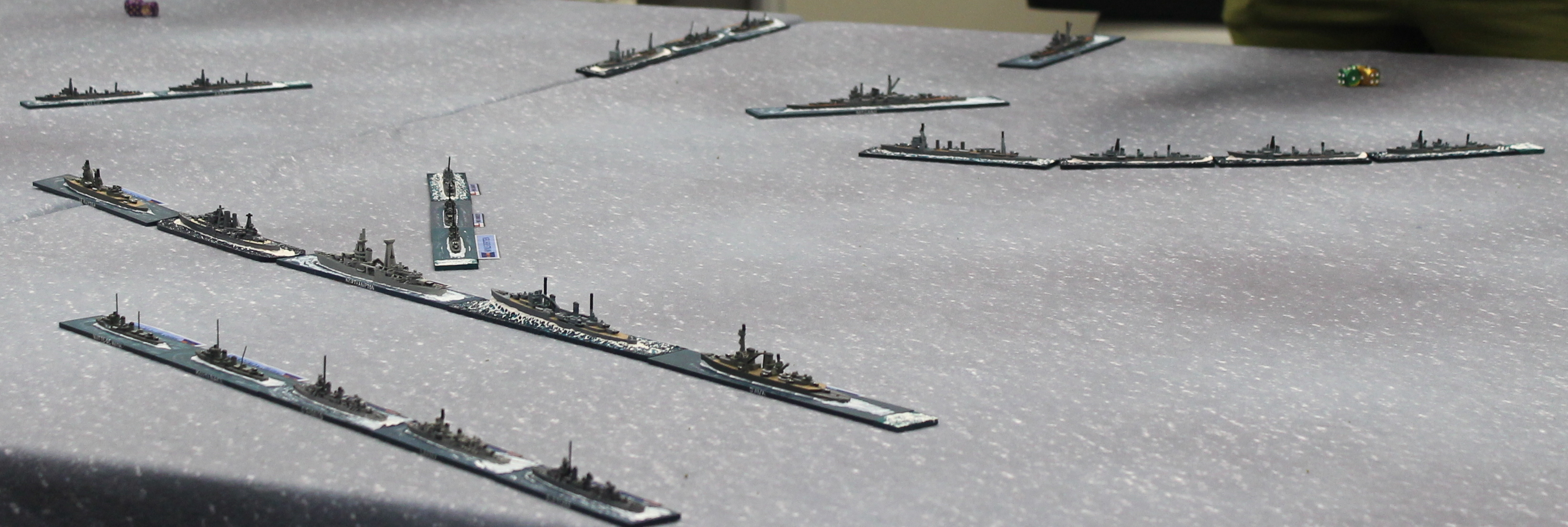
The ABDA team opened strongly, their gunfire quickly sinking a Jap destroyer. An initial mass volley of Japanese torpedoes found no targets, but as the fleets closed to secondary gun range both fleets started taking serious damage...

The IJN, disconcerted by their historically awkward location far from the transports they were charged with protecting, moved quickly to get between the invasion force and the ABDA fleet. The two Jap heavy cruisers slowed to normal speed, accepting the vulnerability that presented to allied torps...


A second volley of Allied torpedoes focused on the Mogami, which succumbed to a torpedo hit and previous gunfire damage! This was clearly the point at which the Japanese had to play the confusion card - rolling like a boss, up to 5 Allied ships were promptly sent to where they could do no harm!

Sounds like a really satisfying game for both teams - and with a nice table and great models. Good one!
ReplyDeleteThanks so much for your kind comment Andy!
DeleteA great looking game as always Ralph, even though naval games are not my thing at all!
ReplyDeleteThanks Steve very kind of you to say so!
DeleteGood AAR, seems like a interesting scenario. Some of the ships have an extra wake token/base behind them. Is that a marker or is it to upsize their base?
ReplyDeleteThanks Dave! Yes, the extra wave marker denotes the ship has moved fast. (Pretty essential in a torpedo infested environment!)
DeleteVery interesting, especially how you balanced the game.
ReplyDeleteI played a 1 vs 1 "Based on Java Sea" also using Nimitz at a similar time.
I reduced destroyer numbers to about a quarter, but represented all the cruisers.
Allies objective was to break through and exit the Japanese baseline.
Allied shops could only make formation with ships of the same navy (Brits and Aussies allowed to team up).
Sun sets after turn six.
This looked like a pushover for the Japanese with superior torpedoes and more 8" guns.
To balance I added:
Houston - no problem: All turrets in working order.
Exeter Radar: Extremely exaggerated, she ignores night time conditions.
It played fast under Nimitz.
My Japanese opponent struggled to angle his ships where the enemy wished to go.
This allowed me to dash past one flank with the Japanese in pursuit.
Exeter and Sydney got through to munch on the invasion transports.
The other allies went down fighting, mostly to torpedoes, but a couple of destroyers hit by 8" gunfire.
Conclusions:
Japanese torpedoes are lethal and not reflected in ship point values.
Those ageing Japanese light cruisers are hopeless gun platforms and mainly useful for their torpedoes.
A modern Japanese destroyer (Fubuki or later) is a better asset in your fleet.
Thanks Steve. Just goes to show the Allies can claim victory with a more balanced scenario! I think I agree with all of your conclusions - points values are always a bug bear and raised some issues during playtesting, although overall I think they are about right.
DeleteI view points values as "more a guideline than a rule", especially when basing games on actual battles.
ReplyDeleteMy two key guidelines when putting history on he table are:
* Consider whether the rules overly advantage / under price certain units.
* Reduce the numbers of small and mostly harmless "speedbump" units.
In Napoleonics those often mean:
* Some heavy sanction for losing the Imperial guard.
* Ensure the game won't bog down behind dozens of skirmish screens.
In Naval it's:
* Ensure the main units (Capital ships, or cruisers if no capital ships present) stats are correct.
* Reduce the numbers of destroyers present.
I find that historically accurate destroyer numbers can reduce Nimitz games to a grind.
Your mileage may vary.
Thanks Steve - entirely agree with your approach.
Delete